




















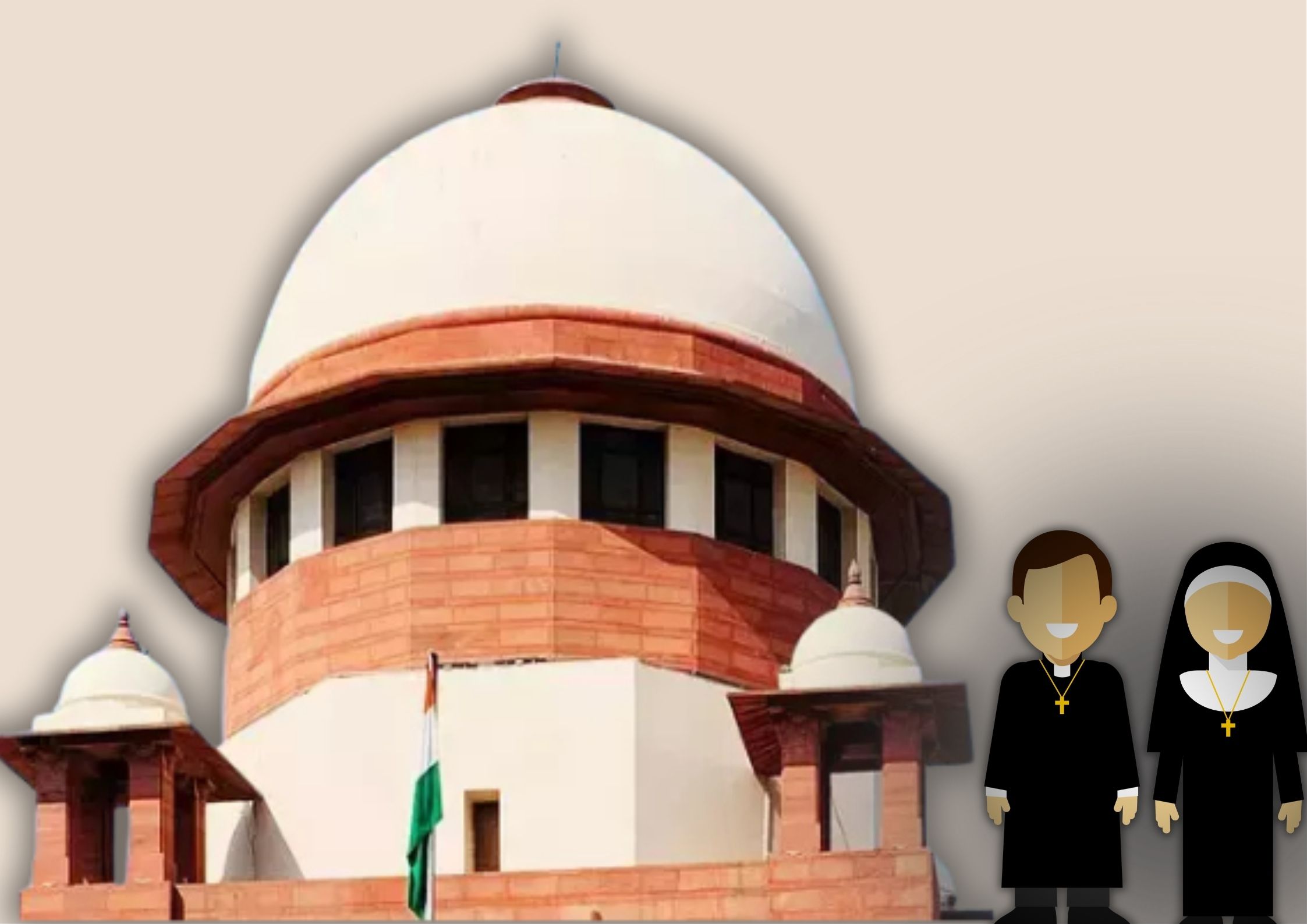
In a significant tax ruling, the Supreme Court has dismissed review petitions challenging its earlier decision to uphold the applicability of Tax Deducted at Source (TDS) on salaries paid to nuns and priests employed as teachers in government-aided educational institutions.
Bench Dismisses Plea for Review
A bench comprising Chief Justice Sanjiv Khanna, Justice JB Pardiwala, and Justice Manoj Misra ruled there were no valid grounds to reconsider the previous judgment. The order, dated April 2025, stated:
“Having gone through the review petitions and also the documents enclosed, we do not find any good ground and reason to review the order dated 07.11.2024. Accordingly, the review petitions are dismissed.”
One of the petitions was noted as dismissed after withdrawal. The Court also declined the request for an open court hearing.
Background of the Case
The controversy dates back to a Madras High Court ruling, where the Division Bench overturned a Single Judge’s decision that had exempted Catholic clergy from TDS liability. The Single Bench had earlier accepted the argument that priests and nuns, due to their vow of poverty and “civil death” under Canon Law, do not personally accrue income and hence are not liable for TDS.
However, the Division Bench comprising Justices Dr. Vineet Kothari and C.V. Karthikeyan disagreed. They held that:
-
The salaries were credited directly to the individuals (nuns/priests).
-
The act of surrendering their income to the Church or Diocese afterward amounted to an application of income, not a diversion at source.
-
The Church or religious institutions had no legal entitlement to the salary at the time of payment, and were not parties to the employment contracts.
Supreme Court’s Position on Uniform Taxation
In its earlier hearing in November 2024, the bench led by then CJI DY Chandrachud, along with Justices Pardiwala and Misra, had emphasized the principle of uniformity in tax law. The Court had observed:
“Whether it is a Hindu priest or a Christian nun, if someone is employed and drawing a salary, TDS must be deducted. The religious or charitable use of income post-receipt does not alter the obligation to deduct tax at source.”
Senior Advocate Arvind Datar, representing some appellants, had argued that nuns and priests should be exempt since they do not retain the income and have technically undergone “civil death.” He also invoked an old CBDT circular suggesting TDS exemptions for religious figures. However, the Court found these arguments insufficient.
The bench reiterated that:
-
Under Section 192 of the Income Tax Act, TDS applies to salary payments, irrespective of religious status.
-
The religious character of an individual does not affect their tax obligations if they are receiving salary in their personal capacity.
Key Legal Concept: Application vs. Diversion of Income
The Court relied on the Kerala High Court’s ruling in Fr. Sabu P Thomas v. Union of India, which clarified that diversion of income by overriding title requires a pre-existing legal right of the third party (in this case, the Church or Diocese) to receive the salary directly from the payer.
In this matter, since the State paid salaries to the teachers directly, and only afterward did the clergy voluntarily transfer the income to their institutions, it was considered application of income—and hence taxable in the hands of the individual recipients.
Final Outcome
The case titled Institute of the Fransican Missionaries of Mary & Others v. Union of India (Review Petition (Civil) No. 496/2025 in SLP (C) No. 10456/2019), marks a clear affirmation by the Supreme Court that employment-based income is subject to tax laws, regardless of the spiritual or religious identity of the employee.
This ruling is expected to impact thousands of priests and nuns engaged in teaching roles across India, reinforcing the principle that TDS applies uniformly to all salaried individuals under Indian law.