























SC: The ingredient of mens rea cannot be assumed to be ostensibly present
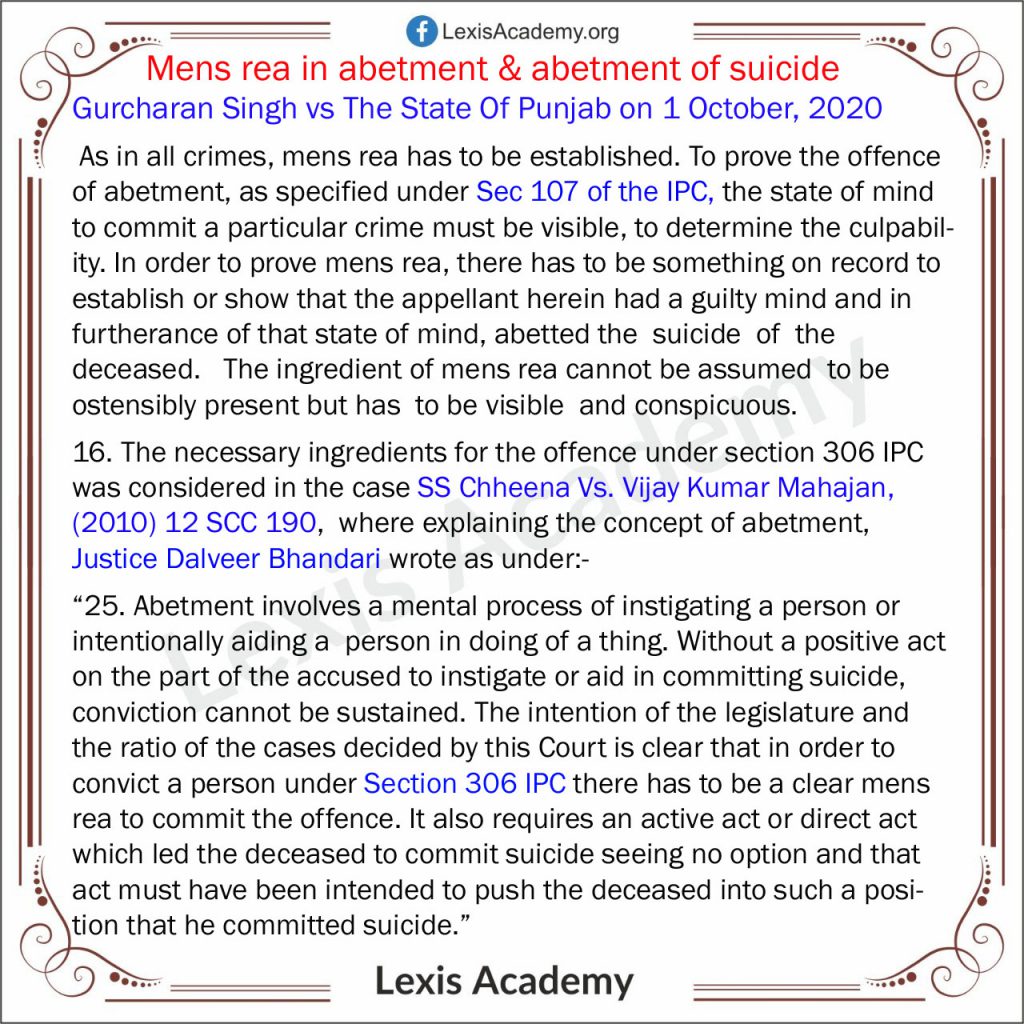
The Hon’ble Supreme Court, on 1st October 2020, in the matter of Gurcharan Singh v. The State of Punjab pronounced that in order to prove mens rea, there has to be something on record to establish or show that the accused had a guilty mind. The ingredient of mens rea cannot be assumed to be ostensibly present but has to be visible and conspicuous.
The Hon’ble Supreme Court observed that:
Whenever a person instigates or intentionally aids by any act or illegal omission, the doing of a thing, a person can be said to have abetted in doing that thing.
As in all crimes, mens rea has to be established. To prove the offence of abetment, as specified under Sec 107 of the IPC, the state of mind to commit a particular crime must be visible, to determine the culpability. In order to prove mens rea, there has to be something on record to establish or show that the accused had a guilty mind and in furtherance of that state of mind, abetted the suicide of the deceased. The ingredient of mens rea cannot be assumed to be ostensibly present but has to be visible and conspicuous.
While dealing with a case of abetment of suicide in Amalendu Pal alias Jhantu vs. State of West Bengal, (2010) 1 SCC 707 Dr. Justice M.K. Sharma writing for the Division Bench explained the parameters of Section 306 IPC in the following terms:
“12. Thus, this Court has consistently taken the view that before holding an accused guilty of an offence under Section 306 IPC, the court must scrupulously examine the facts and circumstances of the case and also assess the evidence adduced before it in order to find out whether the cruelty and harassment meted out to the victim had left the victim with no other alternative but to put an end to her life. It is also to be borne in mind that in cases of alleged abetment of suicide there must be proof of direct or indirect acts of incitement to the commission of suicide.
Merely on the allegation of harassment without there being any positive action proximate to the time of occurrence on the part of the accused which led or compelled the person to commit suicide, conviction in terms of Section 306 IPC is not sustainable.
13. In order to bring a case within the purview of Section 306 IPC there must be a case of suicide and in the commission of the said offence, the person who is said to have abetted the commission of suicide must have played an active role by an act of instigation or by doing certain act to facilitate the commission of suicide. Therefore, the act of abetment by the person charged with the said offence must be proved and established by the prosecution before he could be convicted under Section 306 IPC.
18. In the case Mangat Ram Vs. State of Haryana, (2014) 12 SCC 595 which again was a case of wife’s unnatural death, speaking for the Division Bench, Justice K.S.P. Radhakrishnanan rightly observed as under:-
“24. We find it difficult to comprehend the reasoning of the High Court that “no prudent man is to commit suicide unless abetted to do so”. A woman may attempt to commit suicide due to various reasons, such as, depression, financial difficulties, disappointment in love, tired of domestic worries, acute or chronic ailments and so on and need not be due to abetment. The reasoning of the High Court that no prudent man will commit suicide unless abetted to do so by someone else, is a perverse reasoning.”
Relevant paragraph from Judgement